
Sunscreen is the single most important skincare product you can use. It protects you from UV damage, prevents premature ageing, reduces hyperpigmentation, and lowers the risk of skin cancer. Yet so many people skip it, because they hate the white cast, the greasy feel, or the way it pills under makeup.
This guide solves every one of those problems and you know about how to apply the sunscreen on your face. By the end, you will know exactly how to apply sunscreen so it looks invisible, feels comfortable, and works perfectly under your makeup.
Why SPF Is Non-Negotiable
UV rays are the number one cause of premature ageing, ahead of stress, diet, and pollution combined. They penetrate through clouds, glass windows, and even on overcast days. Without daily SPF:
• Collagen breaks down faster, causing wrinkles and sagging
• Dark spots and hyperpigmentation appear and worsen
• Skin texture becomes uneven and rough over time
• Risk of skin cancer increases significantly
Dermatologists universally agree: SPF is the most anti-ageing product that exists. Even a basic SPF 30 used consistently will preserve your skin far better than any serum or cream.
Chemical vs Mineral Sunscreen: Which Is Better for Your Face?
Chemical Sunscreen
Chemical SPF absorbs UV rays and converts them into heat. It tends to be:
• Lightweight and invisible on all skin tones
• Easier to wear under makeup without pilling
• Better for day-to-day use and darker skin tones (no white cast)
• Needs to be applied 15–20 minutes before sun exposure to activate
Mineral Sunscreen (Physical SPF)
Mineral SPF sits on top of skin and reflects UV rays. It tends to be:
• Gentler on sensitive and acne-prone skin
• Effective immediately upon application
• More likely to leave a white cast on darker skin tones
• Thicker and can feel heavy, look for tinted versions to reduce cast
| �� Which to choose: For everyday makeup use, a lightweight chemical SPF or a tinted mineral SPF gives the most seamless finish. Pure mineral SPF is better if you have very reactive skin. |
How to Apply to Your Face & How Much
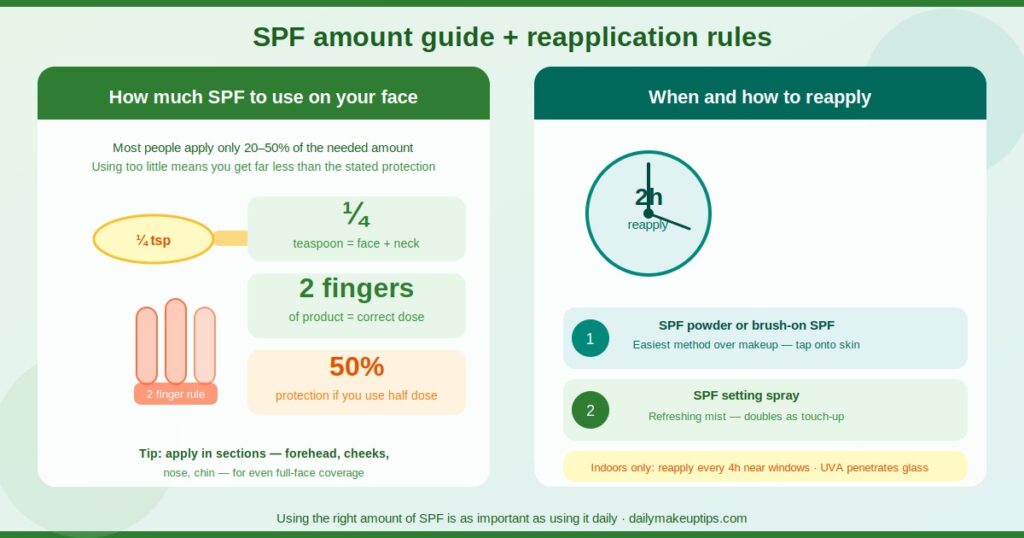
This is where most people go wrong. The amount matters enormously, applying too little reduces the protection significantly. The most important thing is how to apply the sunscreen on your face and how much is necessary.
The rule: use a nickel-sized amount (about 1/4 teaspoon or 2 fingers’ worth of product) for your face and neck. This sounds like a lot, but it is what clinical SPF testing is based on. Using half that amount means you are getting approximately half the protection.
Step-by-Step: How to Apply Sunscreen on Your Face
Step 1: Apply After Moisturiser, Before Makeup
Sunscreen goes on after your moisturiser (and any serums) but before primer and foundation. This is the correct skincare-to-makeup layering order:
1. Cleanser
2. Toner (if using)
3. Serum
4. Moisturiser
5. Sunscreen ← here
6. Primer
7. Foundation
Step 2: Apply in Sections for Even Coverage
Dot the sunscreen across your face, forehead, both cheeks, nose, and chin. Then use clean fingertips or a flat brush to blend it gently across each section. Work in downward strokes to avoid lifting fine hairs.
Do not forget your ears, hairline, and the back of your neck if they will be exposed.
Step 3: Wait Before Applying Makeup
For chemical SPF, wait at least 2–3 minutes after application before applying primer or foundation. This allows the sunscreen to bond to your skin and reduces pilling. If you are using mineral SPF, you can apply makeup immediately.
Step 4: Reapply Every 2 Hours (If Outdoors)
SPF degrades with sun exposure and wears off over time. If you are outdoors, you need to reapply every 2 hours. For most people this means:
• SPF powder or brush-on SPF over makeup, the easiest method
• SPF setting spray, practical and refreshing
• Blotting, then re-applying SPF with a sponge before patting makeup back on
How to Stop Sunscreen Looking White on Your Skin
For Dark and Medium Skin Tones
• Use a chemical SPF, these have no white cast
• Try tinted mineral sunscreens that match your skin tone
• Look for formulas specifically marked ‘no white cast’ or ‘sheer finish’
• Rub it in thoroughly and allow it to absorb before judging the cast
For Light Skin Tones
• Even mineral SPF can leave a slight cast on lighter skin, apply in thinner layers
• Mixing a small amount with your moisturiser reduces the white cast
• Apply foundation over the top, this neutralises most white cast
| ✨ Best no-cast formulas: La Roche-Posay Anthelios UV Correct SPF 50, EltaMD UV Clear, Beauty of Joseon Relief Sun, and Purito Centella Unscented Sun are all widely loved by people of all skin tones. |
How to Wear Sunscreen Under Makeup Without Pilling
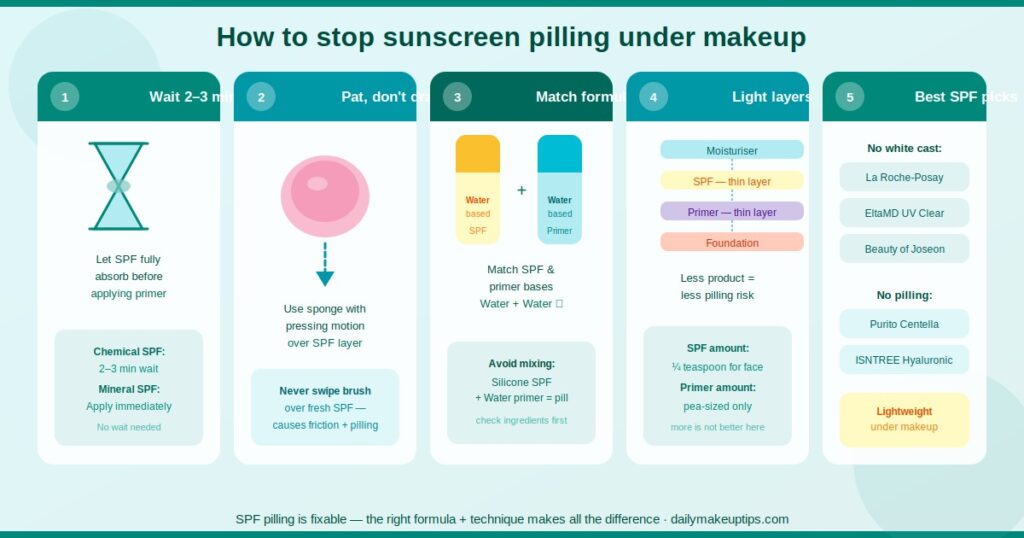
SPF pilling where it balls up under your makeup, is caused by incompatible formulas or not letting layers dry between applications. Here is how to fix it:
• Wait 2–3 minutes after SPF before applying primer
• Use a water-based moisturiser and SPF if your makeup is silicone-based
• Apply foundation with a patting motion (not dragging) over SPF
• Use a sponge rather than a brush over freshly applied SPF
• Avoid SPF formulas with high silicone content if you use silicone-based primer
| �� Internal Link: For the full skincare-to-makeup layering guide, read The Complete Skincare Routine for Beginners (Morning & Night). |
SPF in Foundation: Does It Count?
Many foundations contain SPF 15 or SPF 20. While this provides some protection, it is not enough on its own for two reasons:
• You do not apply enough foundation to reach the SPF listed on the label
• Foundation is not evenly distributed like dedicated SPF
SPF in foundation is a bonus, not a substitute. Always apply a dedicated sunscreen first.
Final Thoughts
Sunscreen is the simplest, cheapest, and most effective anti-ageing and skin health investment you can make. The key is using enough, applying it in the right order, and choosing a formula that works for your skin type and skin tone.
Once you find your perfect SPF formula and build it into your routine, it takes about 30 seconds and becomes as automatic as brushing your teeth. Your skin, 10 and 20 years from now, will thank you.