

Contouring uses light and shadow to sculpt the face, making it appear slimmer, more defined, and more symmetrical. When done well, it is completely undetectable, people simply think your bone structure is exceptional.
This beginner’s guide covers the essential technique, the right products, and how to adapt it to every face shape.
Bronzer vs Blush: What is the Difference?
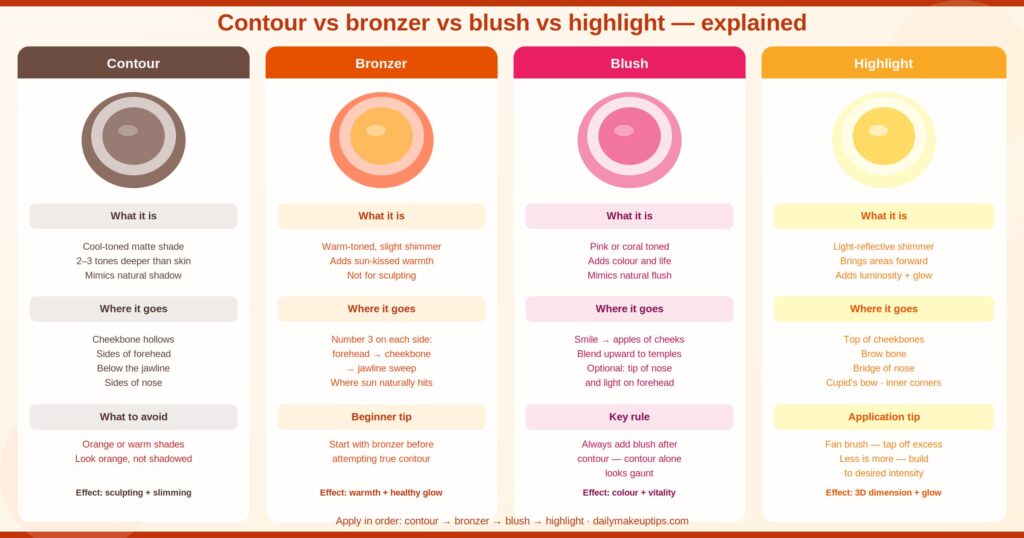
• Contour: a cool-toned, matte shade 2–3 tones deeper than your skin. Mimics natural shadow to recede areas of the face
• Bronzer: a warm-toned, slightly shimmery shade that adds a sun-kissed warmth. Goes where the sun would naturally hit the face
• Blush: a pink or coral tone applied to the cheeks to add colour and a healthy glow
All three work together, contour creates structure, bronzer adds warmth, blush adds life. Most beginners skip contour and use bronzer for a soft, natural-looking definition.
| Beginner rule: Start with bronzer before attempting contour. Bronzer is warmer and more forgiving. True contour (cool-toned) is harder to blend naturally but creates more dramatic results. |
Choosing the Right Contour Product
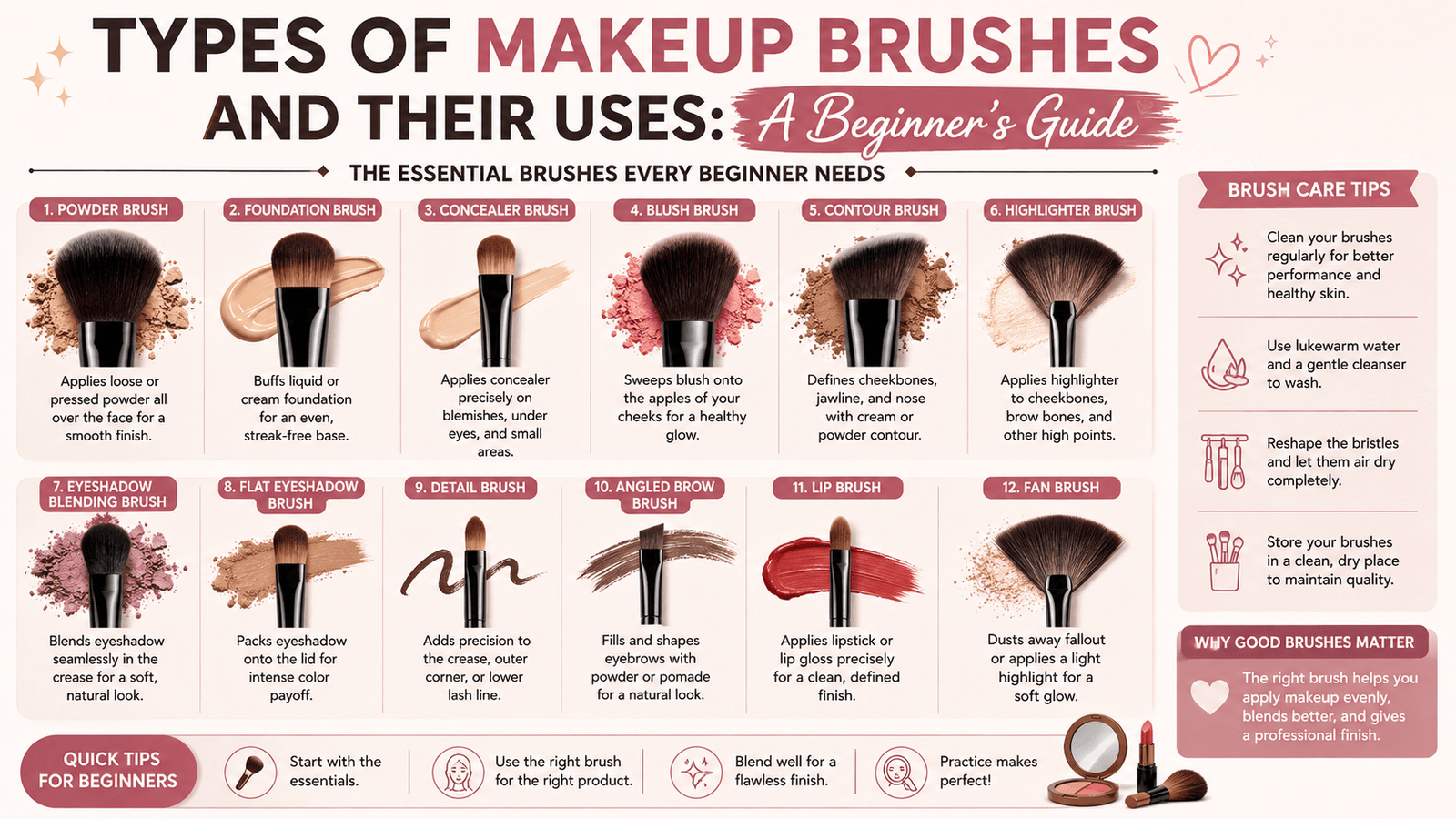
For Beginners: Contour Powder or Bronzer
Powder products are more forgiving and easier to blend out. Choose a matte powder 2 shades deeper than your skin tone with a cool (grey-brown) undertone, not an orange or warm brown, which reads as bronzer rather than shadow.
Intermediate: Contour Stick
Contour sticks allow precise application but require quick blending before the product sets. Draw the stick directly onto the skin and blend immediately with a brush or sponge.
Advanced: Cream Contour
Cream contour gives the most sculpted, high-definition result but is the hardest to blend naturally. Apply before powder products and blend with a damp sponge.
The Essentials
Cheekbones
Suck in your cheeks slightly to find the hollow beneath the cheekbone. Apply contour in this hollow, starting from the ear and blending toward the corner of your mouth, but stopping halfway. Do not take the contour all the way to the mouth or it looks dirty rather than sculpted.
Forehead
Dust contour along the hairline in a curved shape. This recedes the forehead and makes the face appear more oval. Blend thoroughly, harsh lines here are very obvious.
Jawline
Apply contour just below the jawline and blend downward onto the neck. This creates the illusion of a sharper jaw and slimmer face. Most noticeable in photos.
Nose (Optional)
For a slimmer-looking nose, apply a thin line of contour down each side of the nose bridge and blend. This is the most technically difficult placement, skip it until you are comfortable with cheek contouring.
Blush and Bronzer Placement Guide
Bronzer
Apply bronzer in the shape of a number 3 on each side of the face, starting at the forehead, sweeping across the cheekbone, and ending along the jawline. This mimics where the sun naturally tans the face.
Blush
Smile gently and apply blush to the apples of the cheeks, blending upward toward the temples. For a lifted look, focus the blush higher on the cheekbone rather than directly on the apple. For a natural look, blend a little down the nose as well.
Highlight
Apply a shimmery highlighter to the highest point of the cheekbones, the brow bone, the tip of the nose, the Cupid’s bow, and the centre of the forehead. Highlighting these points draws attention forward and makes the face appear more three-dimensional.
How to Contour Different Face Shapes
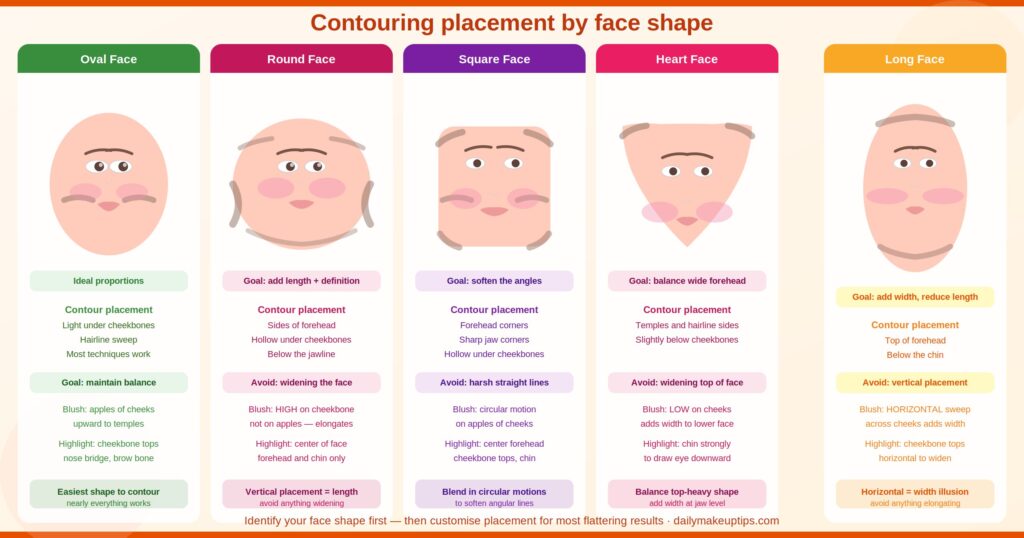
Round Face
Goal: add length and definition. Contour the sides of the forehead, the hollows of the cheeks, and beneath the jaw. Apply blush high on the cheekbones rather than on the apples to elongate. Avoid applying highlight to the widest parts of the face.
Square Face
Goal: soften the angles. Contour the corners of the forehead and the sharp corners of the jaw. Apply blush in a soft circular motion on the apples of the cheeks.
Oval Face
The oval face is considered the ideal proportions — most contouring techniques work well. A light contour under the cheekbones and along the hairline is sufficient.
Heart-Shaped Face
Goal: balance the wider forehead with the narrower chin. Contour the temples and sides of the forehead. Apply blush low on the cheeks to add width to the lower face.
Long Face
Goal: add width and reduce length. Contour the top of the forehead along the hairline and beneath the chin. Apply blush horizontally across the cheeks rather than upward.
Common Contouring Mistakes
• Using a warm bronzer as contour it looks orange, not shadowed
• Applying too much product at once build gradually
• Not blending enough there should be no visible lines
• Contouring in unflattering lighting always check in natural daylight
• Skipping blush contour without blush looks gaunt and flat
Final Thoughts
Contouring is a sculpting technique, not a coverage one. Start with a light hand, a good matte bronzer, and focus on the cheekbones. Once that feels natural, add the forehead and jawline placements. Within a few weeks, sculpting your face will feel as routine as applying mascara.