


Have you ever bought a foundation that looked perfect in the bottle but completely wrong on your face?
Maybe it looked too orange, too pink, too yellow, too dark, or too light. Perhaps it matched your hand but looked strange on your face. This is why many people struggle when they try to choose foundation shade.
Finding the right foundation is not just about deciding whether your skin is “light,” “medium,” or “deep.” You also need to understand your undertone and the depth of your complexion.
Your skin tone is the visible color of your skin. Your undertone is the subtle color underneath your skin. Most undertones fall into three main groups: warm, cool, and neutral. Some people also have an olive undertone, which can make shade matching more confusing.
For example, two people may both have medium skin, but one may have golden undertones while the other has pink or neutral undertones. The same foundation shade will not look the same on both people.
The good news is that you do not need to be a professional makeup artist to find your match.
With the right method, you can test foundation correctly, understand shade names, avoid common mistakes, and even find a good match when shopping online.
In this guide, you will learn how to choose the right foundation shade for your skin tone, how to identify your undertone, where to test foundation, why your hand is not the best testing area, how to deal with oxidation, and what to do when you are between two shades.
Let’s make foundation shopping much easier.
What Is the Difference Between Skin Tone and Undertone?
Your skin tone describes how light or deep your skin appears on the surface. Common descriptions include fair, light, medium, tan, deep, and rich. Your skin tone can change slightly because of sun exposure, seasonal changes, or tanning.
Your undertone is the subtle color beneath the surface of your skin. It usually stays more consistent than your surface tone. Understanding both helps you choose a foundation that looks natural instead of sitting on top of your skin like a mask.
Skin Tone vs Undertone
| Skin Tone | Possible Undertones |
| Fair | Cool, warm, neutral |
| Light | Cool, warm, neutral |
| Medium | Warm, neutral, olive |
| Tan | Warm, neutral, olive |
| Deep | Warm, cool, neutral |
Real-Life Example: Two people with medium skin may need completely different foundation shades because one has golden undertones and the other has cool pink undertones.
Pro Tip: First identify your skin depth. Then identify your undertone. You need both pieces of information to properly choose foundation shade.
How to Identify Your Skin Tone
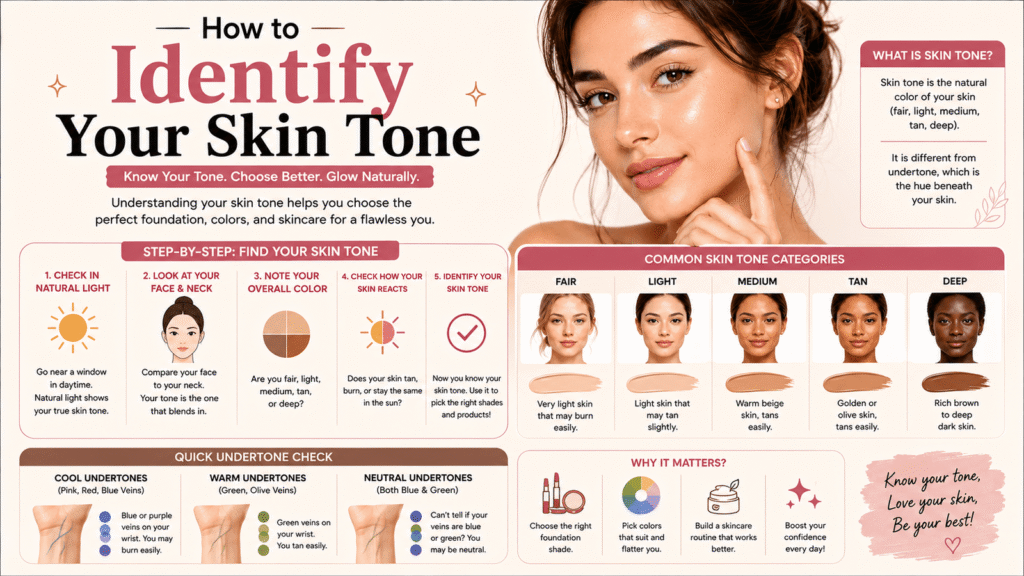
Your skin tone is easier to identify in natural daylight. Stand near a window and look at your face and neck without heavy makeup.
Avoid judging your skin tone under strong yellow indoor lights because artificial lighting can make your skin appear warmer than it really is.
A Simple Skin Tone Guide
- Fair: Very light complexion
- Light: Light complexion with some natural color
- Medium: Moderate complexion with beige, golden, or neutral depth
- Tan: Deeper complexion that may tan easily
- Deep: Rich brown to deep complexion
Your skin tone may also change throughout the year. For example, your winter foundation may look too light after summer sun exposure.
Quick Tip: Match foundation to the skin you want the makeup to blend into, usually your face and neck.
Mini Conclusion: Skin tone tells you how light or deep your foundation should be. Undertone helps you choose the correct color direction.
How to Find Your Undertone
Finding your undertone can feel confusing, but a few simple clues can help.
Warm Undertone
Warm undertones often have golden, yellow, peach, or warm olive tones.
You may notice that gold jewelry looks especially flattering, although jewelry tests are not perfect.
Warm foundations often have words such as:
- Warm
- Golden
- Yellow
- Peach
- Honey
Cool Undertone
Cool undertones often have pink, rosy, red, or bluish tones.
Cool foundation shades may include words such as:
- Cool
- Rose
- Pink
- Red
Neutral Undertone
Neutral undertones sit between warm and cool.
You may find that both gold and silver jewelry look good on you. Foundation shades labeled neutral, natural, or balanced may work well.
Olive Undertone
Olive undertones can have a subtle green, gray, or golden appearance. Some people with olive undertones find that many foundations look too pink or too orange.
Reality Check: Undertone tests are helpful, but they are not perfect. The best test is still how the foundation looks when applied to your face and neck in natural light.
The Best Place to Test Foundation
One of the biggest foundation shade mistakes is testing the product on your hand.
Your hands are often a different color from your face. They may receive more sun exposure or have a different undertone.
The jawline is usually a better place to test foundation because it helps you compare the color of your face with your neck.
The Three-Shade Test
Choose three shades that look close to your complexion. Apply small stripes from your cheek down toward your jawline.
The shade that seems to disappear most naturally into your skin is usually the closest match.
Professional Makeup Artist Trick: Do not judge the shade immediately. Give it a few minutes because some formulas may change slightly as they dry.
Before: A shade may look perfect when first applied.
After: It may become darker or warmer as it sets.
Step-by-Step Guide to Choose Foundation Shade
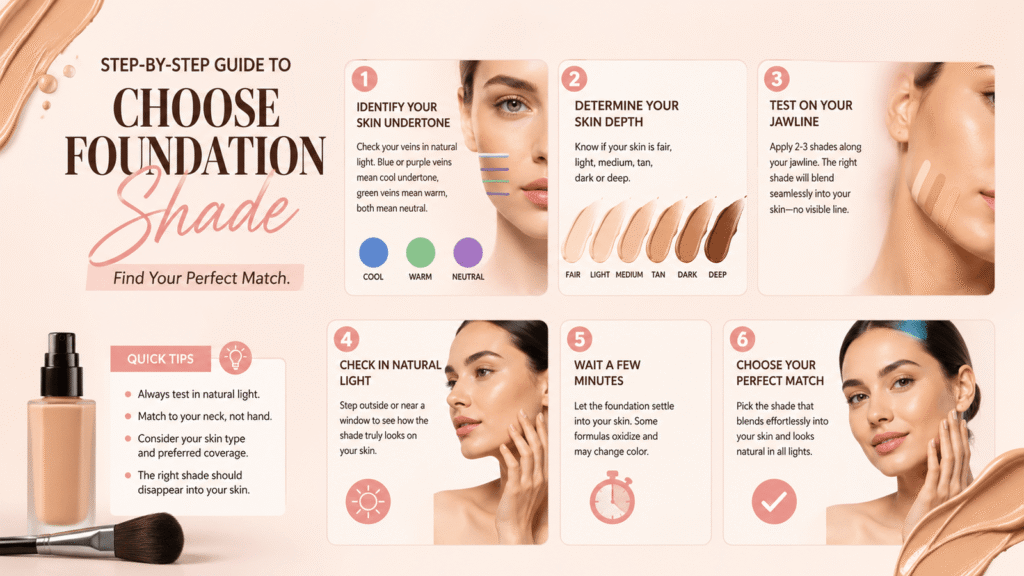
Step 1: Determine Your Skin Depth
Decide whether your skin is fair, light, medium, tan, or deep.
Do not compare your skin to someone else’s. Look at your own face and neck in natural light.
Step 2: Identify Your Undertone
Look for warm, cool, neutral, or olive clues.
Use jewelry and vein color as clues, but do not rely on one test alone.
Step 3: Select a Few Possible Shades
Choose two or three shades that appear close to your complexion.
Avoid testing only one shade if possible.
Step 4: Apply to Your Jawline
Apply small stripes from the cheek toward the jaw.
Do not test only on your hand.
Step 5: Check in Natural Light
Step near a window or go outside briefly if possible.
Artificial lighting can hide a poor match.
Step 6: Wait for the Formula to Set
Some foundations may oxidize or appear slightly different after drying.
Step 7: Choose the Shade That Blends Best
The correct shade should blend smoothly into your skin without creating an obvious line.
Quick Tip: If you can clearly see where the foundation starts and stops, the shade may not be right.
How to Choose Foundation for Different Skin Tones
Fair and Light Skin
People with fair and light skin may struggle with foundations that look too orange, too yellow, or too dark.
Look for shades that match both your depth and undertone.
A fair warm complexion may need a light golden shade, while a fair cool complexion may need a rosy shade.
Common Mistake: Choosing the lightest shade automatically. The lightest shade may still have the wrong undertone.
Medium Skin
Medium skin tones often have many undertone variations.
Some people have golden undertones, while others have neutral, olive, or peach tones.
Pro Tip: Test foundation carefully around the jaw because the wrong undertone can look very noticeable.
Tan Skin
Tan skin can change depending on the season.
You may need a slightly deeper shade during summer and a lighter shade during winter.
Look for foundations with enough depth and the correct undertone.
Deep Skin
Deep skin tones need more than a “dark” shade. The undertone matters just as much.
Some deep complexions have red, golden, neutral, or cool undertones.
Expert Advice: Choose brands with broad shade ranges when possible. A large number of shades does not automatically guarantee perfect coverage of every undertone, so test the actual color carefully.
How Skin Type Affects Foundation Shade Selection
Your skin type does not directly change your undertone, but it affects how the foundation looks after application.
| Skin Type | Suitable Finish |
| Dry | Hydrating or natural |
| Oily | Natural matte or long-wear |
| Combination | Balanced finish |
| Sensitive | Simple, gentle formulas |
| Mature | Flexible, lightweight formulas |
Dry Skin
A very matte foundation may make dry areas more visible.
A hydrating formula may look more comfortable.
Oily Skin
A very rich, dewy foundation may move more easily.
A lightweight formula may offer better wear.
Combination Skin
You may need different techniques on different areas.
For example, you might use less product on the oily T-zone and more hydration on the cheeks.
Mini Conclusion: The best foundation shade must match your color, but the best formula must also match your skin’s needs. Healthy, well-prepared skin can also improve the way foundation looks throughout the day. If you want a brighter and smoother makeup base, learning about the benefits of Vitamin C serum can help you build a better skincare routine before applying foundation.
How to Choose Foundation Online
Online foundation shopping can feel difficult because you cannot test the product directly.
Still, you can improve your chances of finding a good match.
Use These Tips
- Find your shade in a foundation you already own.
- Check the brand’s shade descriptions.
- Compare undertones carefully.
- Look for multiple swatches.
- Check return or exchange policies.
- Avoid judging shade only from a website photo.
Some online tools use digital images or algorithms to help predict foundation shades. However, image-based matching can be affected by lighting, camera settings, and screen color. Research has explored color-calibrated image tools for foundation matching, showing how technology may assist shade selection, but real-world testing still remains valuable.
Reality Check: A shade finder is helpful, but it is not always perfect.
What Is Foundation Oxidation?
Foundation oxidation happens when a product appears to change color after application.
It may look darker, warmer, or slightly different as it dries.
Why Can This Happen?
Possible factors include:
- The formula itself
- Skin oils
- Air exposure
- Skincare underneath
- The foundation’s ingredients
Not every foundation oxidizes, and the effect can vary from person to person.
Pro Tip: Test the foundation and wait several minutes before deciding whether the shade matches.
If the foundation becomes noticeably darker, you may need to consider a different shade.
What If You Are Between Two Foundation Shades?
Many people do not fit perfectly into one shade.
If you are between two shades, you have several options.
Option 1: Choose the Closest Shade
Pick the shade that matches your undertone and is closest to your skin depth.
Option 2: Mix Two Shades
Mixing two shades can help you create a custom match, especially when your skin changes between seasons.
Option 3: Use a Shade Adjuster
Some makeup brands sell color adjusters. Use these carefully because a small amount can change the appearance of the foundation.
Advanced Tip: If your skin tone changes significantly during the year, owning two seasonal shades can be more practical than trying to force one shade to work all year.
Common Foundation Shade Mistakes
Testing on Your Hand
Your hand may not match your face.
Better: Test on your jawline.
Choosing the Wrong Undertone
A foundation can have the correct depth but still look orange, pink, or gray.
Better: Match both depth and undertone.
Trusting Online Photos Completely
Screens and lighting can change how shades appear.
Better: Compare multiple swatches.
Ignoring Oxidation
The first color you see may not be the final color.
Better: Wait before deciding.
Matching Only Your Face
Your face may be lighter or darker than your neck.
Better: Consider the transition between your face, jaw, and neck.
Professional Makeup Artist Tips
Pro Tip: Test at least two or three close shades when possible.
Expert Advice: Apply foundation in natural light before making your final decision.
Quick Tip: If the foundation looks too pink, the undertone may be too cool. If it looks orange or yellow, the undertone may be too warm.
Bonus Trick: Take a photo in natural light after testing a shade. Sometimes a camera can help you notice a mismatch that is difficult to see in a store. After choosing the right foundation shade, you can complete your makeup look by following this easy smoky eye tutorial for beginners to create a balanced and natural finish.
Common Mistake: Choosing a foundation because the shade name sounds like it should match you.
Shade names are not always standardized between brands.
Budget vs Luxury Foundation Shopping
You do not need an expensive foundation to find a good shade match.
Affordable foundations can offer excellent shade options. However, premium brands may offer wider ranges, more specialized undertones, or professional shade-matching services.
Budget Tips
- Test before buying when possible.
- Compare shade descriptions.
- Buy from retailers with return policies.
- Avoid buying a shade only because it is on sale.
- Use a sample before purchasing a full bottle.
Luxury Alternatives
A luxury foundation may offer a special finish or texture, but it still needs to match your skin.
Reality Check: A high price does not guarantee a perfect shade match. No matter which foundation you choose, applying it over a consistent anti-aging skincare routine can help create a smoother-looking base and improve the overall finish of your makeup.
Seasonal Foundation Shade Advice
Your skin may appear different throughout the year.
Summer
Sun exposure may make your skin look deeper.
Winter
Your skin may appear lighter or less tanned.
Dry Weather
Your skin may need a more hydrating formula.
Hot Weather
You may prefer a lighter or longer-wearing formula.
Quick Tip: If your skin changes noticeably during the year, keep two shades or mix shades when necessary.
Foundation Do’s and Don’ts
Do
- Identify your skin depth.
- Understand your undertone.
- Test on your jawline.
- Check in natural light.
- Wait for the formula to settle.
- Consider your neck.
- Check the foundation’s finish.
Don’t
- Match foundation only to your hand.
- Choose the lightest shade automatically.
- Ignore undertone.
- Trust online photos completely.
- Buy a shade only because it is popular.
- Judge the color under strong artificial lighting.
Once you’ve found the perfect foundation shade, completing your makeup with beautifully applied lipstick creates a more polished look. You can also learn how to apply lipstick perfectly without bleeding for a clean, long-lasting finish.
Common Foundation Myths
Myth: Your Foundation Must Match Your Hand
Truth: Your hand may have a different color from your face.
Myth: Everyone Has Only Warm, Cool, or Neutral Undertones
Truth: Some people have olive or mixed undertones.
Myth: The Most Expensive Foundation Has the Best Shade
Truth: A good match depends on color, undertone, formula, and your skin.
Myth: Foundation Should Always Match the Face Exactly
Truth: You should also consider how the shade blends into your jaw and neck.
Did You Know?
The beauty industry continues to expand its product choices and shade ranges. McKinsey’s latest analysis projects the global beauty market to reach approximately $590 billion by 2030, with about 5% annual growth through 2030. This continued growth has encouraged brands to develop more products, shade options, and digital shopping tools.
However, more choices can also make shopping confusing. A foundation with 40 or 50 shades is not automatically easier to match. You still need to understand your own skin depth and undertone.
Foundation Shade Buying Checklist
Before buying, ask yourself:
☐ What is my skin depth?
☐ What is my undertone?
☐ Does the shade match my jawline?
☐ Did I test it in natural light?
☐ Did I wait for the formula to settle?
☐ Does the formula suit my skin type?
☐ Can I return or exchange it if needed?
Final Thoughts
Choosing the right foundation shade becomes much easier when you stop focusing only on whether your skin is light, medium, or deep.Your undertone matters just as much.A foundation can have the right depth but still look wrong if the undertone does not match. That is why testing, natural lighting, and patience are so important.Remember, you do not need to find the perfect shade instantly. Start by learning your skin, understanding your undertone, and testing products carefully.Also, take care of your skin before applying makeup. Healthy, well-moisturized skin can help foundation look smoother and more natural.The right foundation should enhance your complexion, not hide who you are.Once you understand your skin tone and undertone, choosing your perfect foundation shade becomes easier, smarter, and much less stressful.
Frequently Asked Questions
1. How do I choose the right foundation shade?
Identify your skin tone and undertone, then test two or three shades on your jawline. Check them in natural light and choose the shade that blends naturally.
2. Should foundation match my face or neck?
Your foundation should create a natural transition between your face and neck. The jawline is the best place to test a shade.
3. How do I know my foundation undertone?
Warm undertones look golden or yellow, cool undertones look pink or rosy, and neutral undertones are balanced. Olive undertones may look slightly green or golden.
4. Why does my foundation look orange?
Your foundation may be too warm, too dark, or may oxidize after application. Try a different shade or undertone and wait a few minutes before judging the color.
5. Can I mix two foundation shades?
Yes. Mixing two shades can help create a better match, especially when your skin tone changes with the seasons.










1 Comment
[…] 3. The correct shade should be invisible against your natural skin […]